
Strength Training Over 50: A Simple Home Plan to Start This Week
Three joint-friendly moves, two or three short sessions a week, no gym required. Works over 60, too.
Heads up: KindFitCoach is an AI coach, and this article was written with AI. Every fact below links to the public health source it came from. Information only, not medical advice.
Yes, you can build real strength after 50 (and 60) at home. Aim for 2 or more days a week that work all your major muscles. Start with:
- Chair squats for legs and hips
- Wall push-ups for chest, shoulders and arms
- Glute bridges for glutes and back
- 1–3 sets of 8–12 slow reps, with rest days between
Maybe you used to lift. Maybe you never have. Either way, strength training over 50 isn't about chasing a personal record. It's about getting up from the floor without a second thought, carrying the groceries in one trip, and feeling steady on the stairs. The good news: you can start at home, today, with your own body weight.
Why strength training matters after 50
We all lose some muscle as we age. According to the Arthritis Foundation, that loss runs about 3% to 5% a decade after age 30, and the Foundation calls strength training the best way to regain lost muscle and prevent future loss (Arthritis Foundation, Exercise and Strength Training With Arthritis).
The National Institute on Aging says muscle-strengthening activities improve physical function, make everyday tasks like getting up from a chair, climbing stairs and carrying groceries easier, and help prevent falls and fall-related injuries (National Institute on Aging).
How much do you need?
Less than you might think. The CDC recommends muscle-strengthening activities on at least 2 days a week that work all the major muscle groups: legs, hips, back, abdomen, chest, shoulders and arms (CDC, Adult Activity: An Overview). The NIA adds a useful detail: don't work the same muscle group two days in a row, so your muscles can recover (NIA).
For each exercise, the NIA says one set of 8 to 12 repetitions is effective, and two or three sets may be more effective. If you're a beginner, it suggests starting without weights or bands until you're comfortable with the movements (NIA).
Strength training over 60: one addition
Over 60, the plan below still fits. Once you reach 65, the CDC adds one thing to the weekly list: activities that improve balance, such as walking heel-to-toe or standing up from a seated position (CDC, Older Adult Activity: An Overview). That second example is exactly what a chair squat trains, so you're already partway there.
And if you're wondering whether it's too late: the CDC says people benefit from physical activity throughout life, including as they age, and that some activity is better than none (CDC).
For men and women over 50
The same basic plan works for both. The Arthritis Foundation, in its guide to strength training with arthritis, points out a few differences (Arthritis Foundation):
- Men, even very fit ones, can lose as much as 30% of their muscle over a lifetime, according to the Arthritis Foundation.
- Women lose muscle faster after menopause, the Foundation says, yet it reports that only 1 in 5 women trains with weights.
- For both, strength training and enough protein are the best-studied way to hold on to muscle.
Your 3 starter moves
Together, these three cover your legs, hips, chest, shoulders and arms. No floor push-ups, no barbells, no jumping.
Chair squat
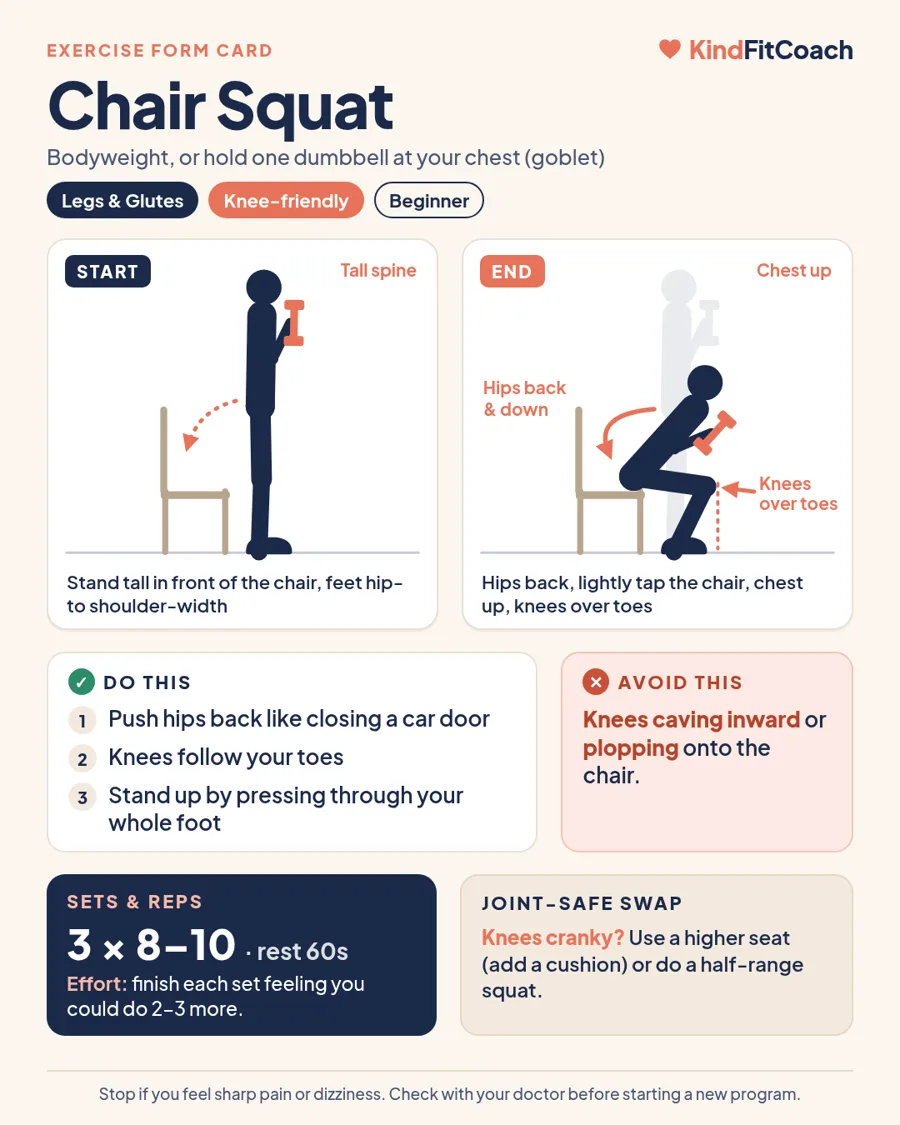
Stand in front of a sturdy chair, feet hip- to shoulder-width apart. Push your hips back, lightly tap the seat, and stand back up by pressing through your whole foot. Keep your chest up and your knees in line with your toes. Hold a dumbbell at your chest once bodyweight feels easy.
Wall push-up
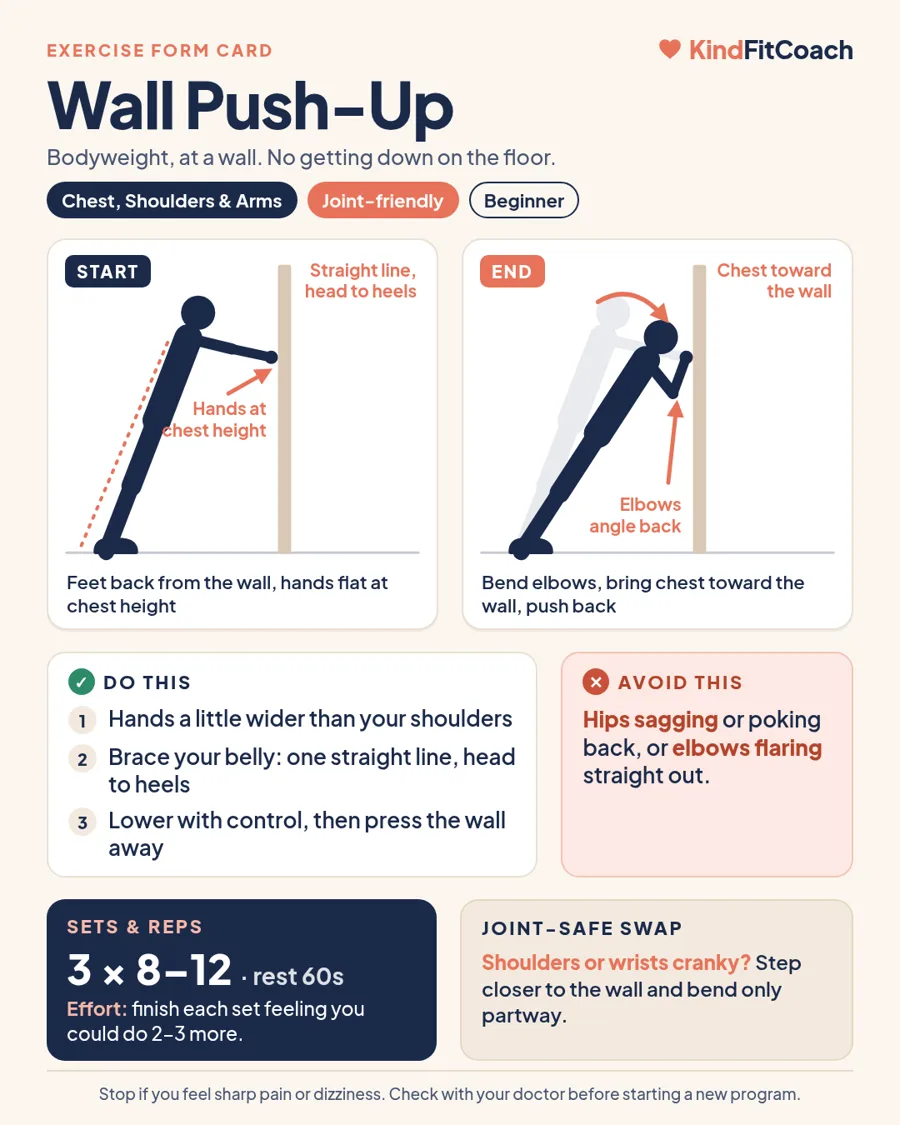
The NIA includes the wall push-up in its sample workout for older adults (NIA, Workout to Go). Stand a little farther than arm's length from a wall, hands flat at about chest height. Keep a straight line from head to heels, bend your elbows to bring your chest toward the wall, then press the wall away.
Glute bridge
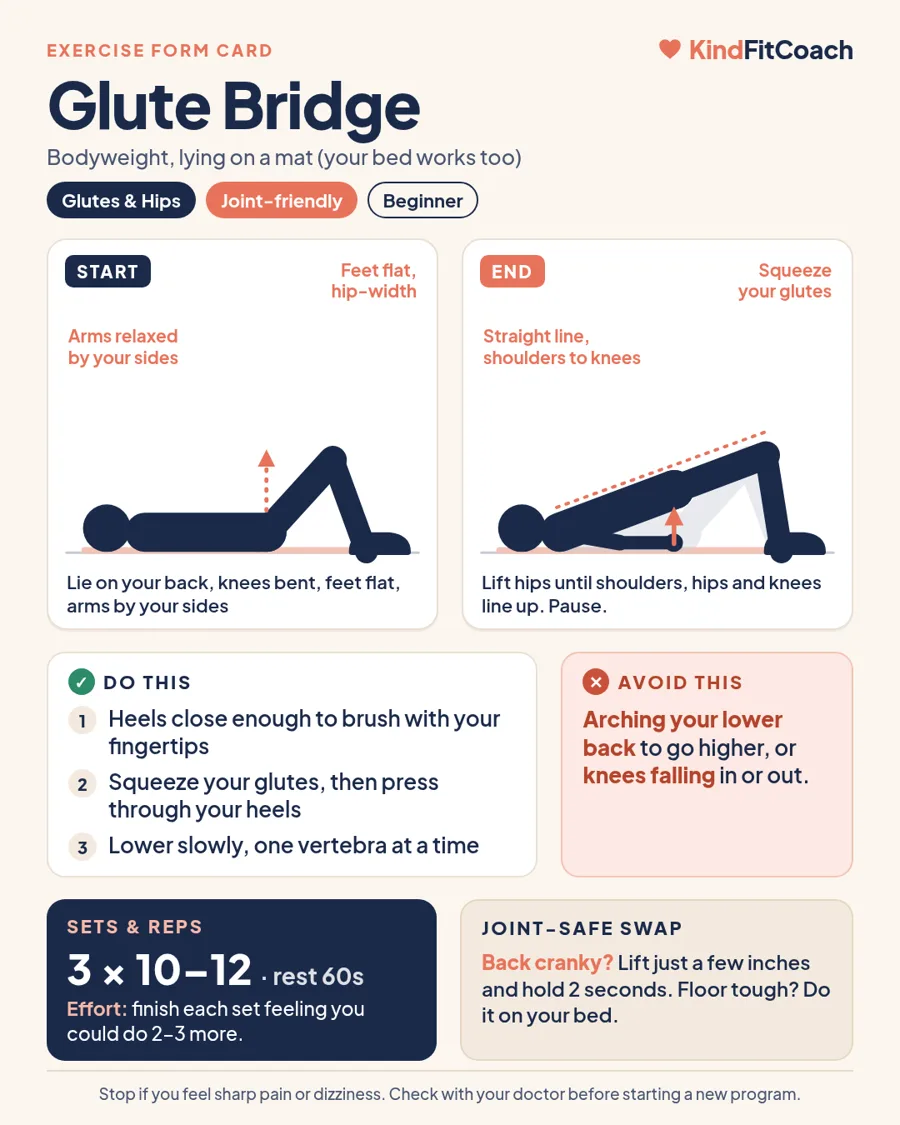
Lie on your back, knees bent, feet flat. Squeeze your glutes, press through your heels, and lift until your shoulders, hips and knees line up. Pause, then lower slowly. Strong glutes help with stairs, hills and getting up off the floor.
When those feel easy, add a back exercise, like a resistance-band row, and a carry: hold a heavy grocery bag in each hand and walk for 30 seconds. The NIA lists both resistance bands and carrying heavy items like groceries as muscle-strengthening activities (NIA).
Not sure where to start?
Take the 2-minute quiz. Your AI coach builds a free Week 1 strength plan around your joints, your equipment and your time.
Get your free Week 1 plan →2-minute quiz · No card needed · Built by an AI coachA simple weekly plan
Two full-body days meets the CDC's minimum. A third is a bonus. Rest days in between follow the NIA's "not two days in a row" advice.
| Day | What to do | Time |
|---|---|---|
| Mon | Strength: chair squat, wall push-up, glute bridge (1–3 sets of 8–12) | 20–30 min |
| Tue | Brisk walk | 20–30 min |
| Wed | Rest, or a walk plus balance practice (heel-to-toe walking) | 15 min |
| Thu | Strength: same three moves, plus a band row or carry | 20–30 min |
| Fri | Brisk walk | 20–30 min |
| Sat | Optional third strength day | 20 min |
| Sun | Rest | – |
Walking days help you work toward the CDC's 150 minutes a week of moderate activity (CDC).
How hard should it feel?
The NIA says strength exercises should take at least a moderate effort (NIA). As a beginner, finish each set feeling like you could do 2 or 3 more good reps. Form comes first. The Arthritis Foundation suggests choosing a weight you can lift with perfect form for 8 to 12 reps, and when that feels easy, adding 2 to 5 pounds or a few more reps (Arthritis Foundation).
Safety checklist
- Warm up for at least 5 minutes with easy walking or arm circles (Arthritis Foundation)
- Breathe out as you lift or push, and never hold your breath (NIA)
- Don't lock your elbows or knees at the top (NIA)
- Move slowly. Smooth, steady reps, no jerking (NIA, Workout to Go)
- Expect some soreness, but exercise shouldn't hurt (NIA)
When to check with a doctor
Talk with your doctor before you start if you have a heart condition, high blood pressure, diabetes, joint problems, recent surgery, or you simply haven't had a checkup in a while. The NIA suggests talking with your doctor if you're unsure about a particular exercise (NIA), and notes that aerobic activity should not cause dizziness, chest pain or pressure, or nausea (NIA). If any of those happen, stop and get medical help.
How KindFitCoach helps
KindFitCoach is an AI coach that works by text. A 2-minute quiz asks about your goals, cranky joints, equipment and schedule, then builds a free Week 1 plan with a form card and a joint-safe swap for every move. Each week, a quick text check-in asks how it went and adjusts the next week. It's not a doctor or a trainer standing next to you, and it's honest about that. Launch offer: free for 2 weeks — first charge on day 16, cancel anytime before — then $7.99 a month (or $99 a year).
Frequently asked questions
Is it too late to start strength training at 50 or 60?
No. The CDC says people benefit from physical activity throughout life, including as they age, and that some activity is better than none. Start with bodyweight moves and build slowly.
How many days a week should I strength train over 50?
The CDC recommends at least 2 days a week that work all major muscle groups. The NIA suggests not working the same muscle group two days in a row.
How many reps and sets should I do?
The NIA says one set of 8 to 12 repetitions of each exercise is effective, and two or three sets may be more effective. Beginners can start without weights.
Do I need weights to start?
No. Your body weight is enough to start: chair squats, wall push-ups and glute bridges. Add light dumbbells or a resistance band when 12 good reps feel easy.
Is strength training different for women over 50?
The basic plan is the same. According to the Arthritis Foundation, women's muscle loss speeds up after menopause, which makes regular strength training especially worthwhile.
How long until I see results?
It varies from person to person. In its guidance for people with arthritis, the Arthritis Foundation says it can take six to eight weeks to notice fitness gains, though pain, fatigue and mood may improve sooner. Consistency matters more than intensity.
Get a strength plan made for you
Answer 12 quick questions and get your free Week 1 plan by text, with form cards and a joint-safe swap for every move.
Get your free Week 1 plan →2-minute quiz · No card needed · Built by an AI coachSources
How we write these: Written by the KindFitCoach team using guidance from the CDC, NIH, and other cited sources. Last updated October 19, 2026.
- CDC: Adult Activity: An Overview
- CDC: Older Adult Activity: An Overview
- National Institute on Aging: Three Types of Exercise Can Improve Your Health and Physical Ability
- National Institute on Aging: Workout to Go (sample exercise routine, PDF)
- Arthritis Foundation: Exercise and Strength Training With Arthritis