
Leg Exercises for Bad Knees: 5 Gentle Moves You Can Do at Home
Stronger legs, calmer knees. About 20 minutes, three days a week, with a chair and a wall.
Heads up: KindFitCoach is an AI coach, and this article was written with AI. Every fact below links to the public health source it came from. Information only, not medical advice.
The best leg exercises for bad knees strengthen the muscles that support the knee (thighs, hamstrings and glutes) without impact or deep bending. Start here:
- Chair squats to a comfortable depth
- Glute bridges
- Seated knee extensions, shallow wall sits and side steps
- 2–3 days a week, slow reps, no sharp pain
If your knees grumble on the stairs, you don't have to give up on leg day. Stronger legs often help cranky knees. The trick is choosing moves that build muscle without pounding or deep bending, and keeping every rep in a range that feels okay.
Below are five knee-friendly moves for home, a weekly plan, and a gentler swap for every move.
Why leg strength helps bad knees
Your knee doesn't work alone. The Arthritis Foundation points to the quadriceps, hamstrings and glutes as the muscles that contribute to healthy knee function and help prevent injury (Arthritis Foundation, 6 Exercises for Knee OA Pain). It adds that these muscles "act like a brace" to protect the joint (Arthritis Foundation, Exercise and Strength Training With Arthritis).
The CDC agrees that moving helps: physical activity can help people with arthritis reduce joint pain and improve function and mood, and it calls physical activity safe for people with arthritis (CDC, Physical Activity and Arthritis).
The one rule: stay in your okay range
You're looking for "working," not "hurting."
- Go slow. Two or three seconds down, two seconds up. No bouncing.
- Shrink the range before you skip the move. A smaller squat still counts.
- Mild stiffness is common at first. The CDC notes that some pain, stiffness or swelling is normal after starting a new program and should get better over time (CDC).
- Breathe out on the effort and don't hold your breath (National Institute on Aging).
- Don't lock your knees straight at the top (NIA).
- Stop if you feel sharp pain, a catch, or your knee gives way. Try the swap, and if it still hurts, save that move for another day.
5 leg exercises for bad knees
Start with the first two, then add the others as you feel ready.
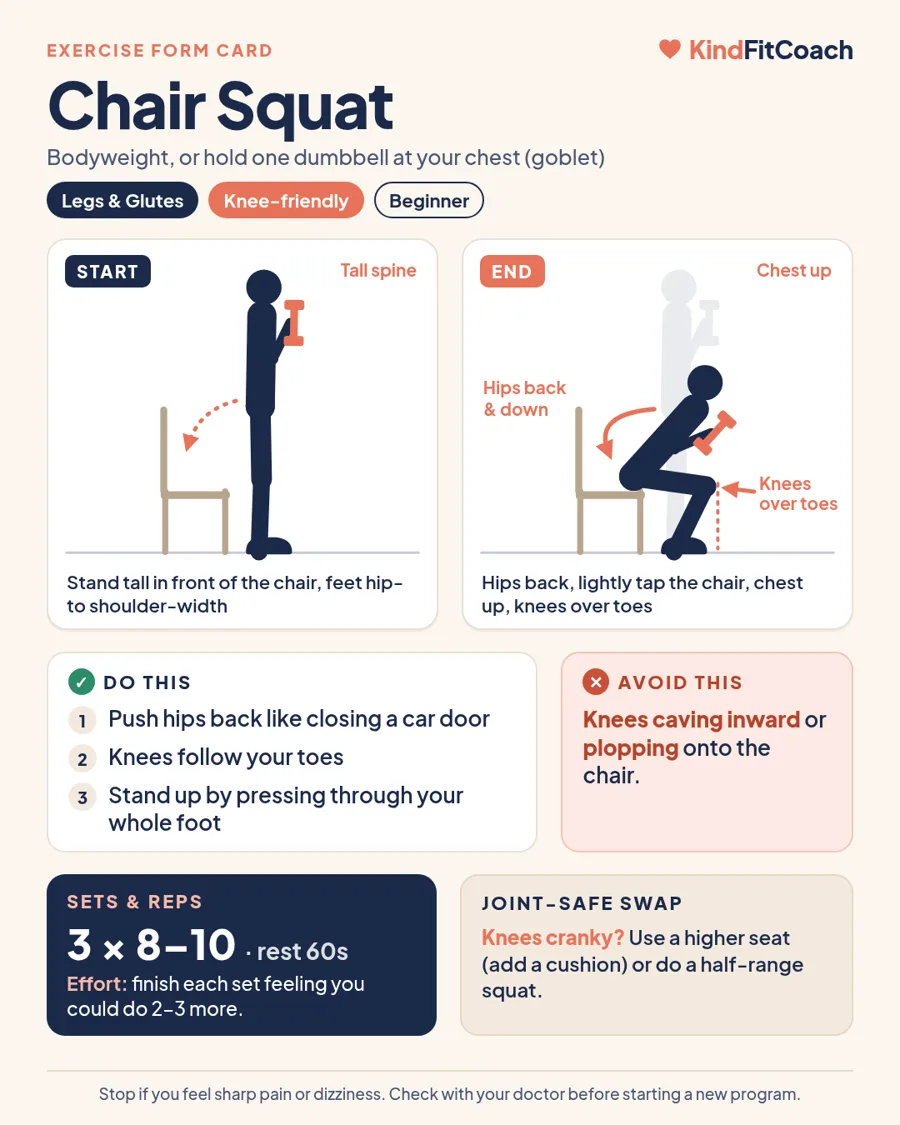
Chair squat
Stand in front of a sturdy chair, feet hip- to shoulder-width apart. Push your hips back like you're closing a car door with your backside, lightly tap the seat, then stand up by pressing through your whole foot. Keep your knees pointing the same way as your toes.
This is basically the sit-to-stand, which the Arthritis Foundation says can make it easier to get up from a chair, in and out of bed, or out of the car (Arthritis Foundation, Knee Exercises).
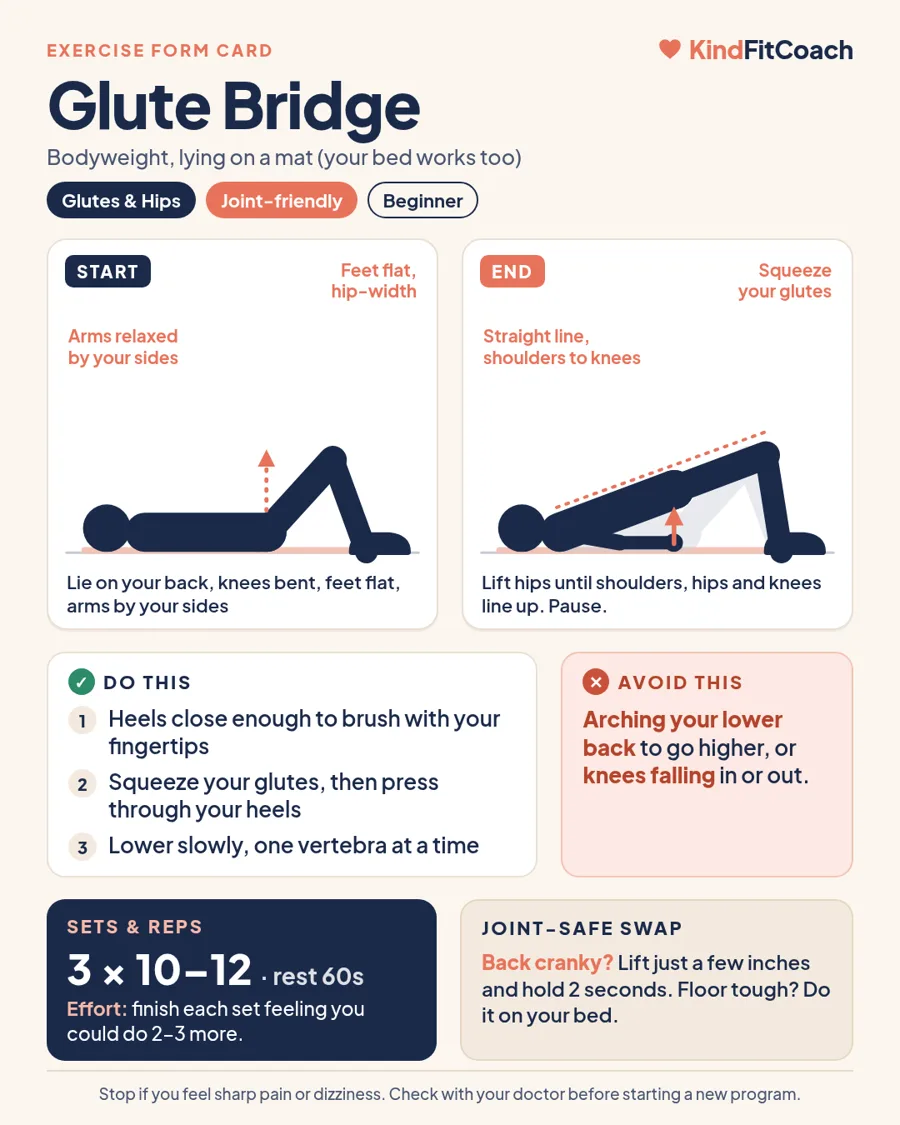
Glute bridge
This works your glutes with very little load on your knees. Lie on your back, knees bent, feet flat and hip-width apart. Squeeze your glutes, press through your heels, and lift until your shoulders, hips and knees line up. Pause, then lower slowly.
The Arthritis Foundation includes a bridge in its knee exercise set to strengthen the lower back, abs, glutes and hamstrings (Arthritis Foundation).
Seated knee extension
Sit tall in a sturdy chair. Plant one foot, then slowly straighten the other leg out in front of you, squeeze the front of your thigh, and hold for about 6 seconds. Lower and switch. The Arthritis Foundation's version loops a resistance band around both legs just above the ankles (Arthritis Foundation).
Wall sit hold (shallow)
The Arthritis Foundation describes isometric exercises, which make a muscle work without moving the joint, as a flare-day option, and calls wall squats a good choice because they strengthen the quadriceps that support the knees (Arthritis Foundation). Lean your back on a wall, feet a step forward, slide down just a few inches, and hold for 10 to 20 seconds.
Side steps
Stand tall with soft knees and take 10 slow steps to the side, then 10 back. The Arthritis Foundation shows side steps with a resistance band to build leg strength and stability (Arthritis Foundation).
Want this built around your knees?
Take the 2-minute quiz. Your AI coach builds a free Week 1 plan around your joints, your equipment and your schedule.
Get your free Week 1 plan →2-minute quiz · No card needed · Built by an AI coachYour weekly plan for bad knees
The CDC recommends that adults get muscle-strengthening activity on at least 2 days a week, plus 150 minutes of moderate activity such as brisk walking (CDC, Adult Activity: An Overview). It also says short sessions of 5 or 10 minutes count (CDC). Here's a gentle week that fits those guidelines:
| Day | What to do | Time |
|---|---|---|
| Mon | Legs A: chair squat, glute bridge, seated knee extension | 20 min |
| Tue | Easy walk or bike, flat ground | 15–30 min |
| Wed | Legs B: glute bridge, side steps, shallow wall sit | 20 min |
| Thu | Rest or a gentle walk | Optional |
| Fri | Legs A again | 20 min |
| Sat | Walk, swim or garden: something you enjoy | 15–30 min |
| Sun | Rest | – |
Warm up with 5 minutes of easy walking. For upper-body and core work on the other days, see our simple strength training plan for adults over 50.
How many reps, and how to progress
The Arthritis Foundation suggests starting with one set of 3 to 4 repetitions, working up to 8 to 10 as you get stronger, then adding sets until you're up to three (Arthritis Foundation). Progress in small steps: a physiatrist quoted by the Arthritis Foundation recommends increases of about 10% to 20% (Arthritis Foundation).
Be patient. The same article notes it can take six to eight weeks to notice fitness gains, although pain, fatigue and mood may start to improve sooner (Arthritis Foundation).
When to check with a doctor
If you have arthritis, a past knee injury or surgery, or you're just not sure, talk with your doctor or a physical therapist before you start. The CDC says people with arthritis may benefit from seeing a physical therapist when beginning physical activity (CDC). MedlinePlus, from the National Library of Medicine, says to contact your provider if (MedlinePlus, Knee pain):
- You can't bear weight on your knee, or you have severe pain even at rest
- Your knee buckles, clicks or locks, or you can't fully bend or straighten it
- You have fever, redness, warmth or a lot of swelling around the knee
- You have pain, swelling, numbness or tingling in the calf below the sore knee
- Pain from an injury or accident, or pain that lasts after 3 days of home care
How KindFitCoach helps
KindFitCoach is an AI coach that works by text. A 2-minute quiz asks about cranky joints, equipment and time, then builds a free Week 1 plan with a form card and a joint-safe swap for every move. A weekly text check-in asks how your knees felt and adjusts your plan. It's not a doctor or physical therapist, and it will tell you to check with one when something sounds off. Launch offer: free for 2 weeks — first charge on day 16, cancel anytime before — then $7.99 a month (or $99 a year).
Frequently asked questions
Is it okay to exercise with bad knees?
For most people, yes. The CDC calls physical activity safe for people with arthritis and says it can help reduce joint pain and improve function. Start slowly, stay in a range that feels okay, and talk with your doctor first if you have a diagnosed knee condition or recent injury.
Should I do squats if I have bad knees?
Many people with sore knees do well with a chair squat, because the chair limits how deep you go. If a full chair squat hurts, use a higher seat or a mini squat that bends your knees just a few inches. Stop if you feel sharp pain.
How often should I do knee-friendly leg exercises?
The CDC recommends muscle-strengthening activity at least 2 days a week for adults. Two or three short sessions on non-consecutive days, with easy walking in between, is a good start.
When should I see a doctor about knee pain?
MedlinePlus says to contact your provider if you can't bear weight, have severe pain at rest, your knee buckles or locks, there's fever, redness or a lot of swelling, or pain lasts after 3 days of home care.
Ready for a plan built around your knees?
Answer 12 quick questions and get your free Week 1 plan by text, with form cards and a joint-safe swap for every move.
Get your free Week 1 plan →2-minute quiz · No card needed · Built by an AI coachSources
How we write these: Written by the KindFitCoach team using guidance from the CDC, NIH, and other cited sources. Last updated October 19, 2026.
- CDC: About Physical Activity and Arthritis
- CDC: Adult Activity: An Overview
- Arthritis Foundation: 6 Exercises for Knee OA Pain
- Arthritis Foundation: Knee Exercises
- Arthritis Foundation: Exercise and Strength Training With Arthritis
- National Institute on Aging: Three Types of Exercise Can Improve Your Health and Physical Ability
- MedlinePlus (National Library of Medicine): Knee pain